30 August 2026
This week I have chosen to focus my blog post on Emma Stanford’s “A Field Guide to Digital Surrogates: Evaluating and Contextualizing a Rapidly Changing Resource” (2020) because of my own interest in and past use of digital surrogates in art history. The article briefly highlights the history of digital surrogates—especially through photography—and the inequalities in the materials available digitally to the public.
Especially noteworthy is Stanford’s note on the materials chosen for digitization being influenced by the person or group funding the digitization project, such as the digital collections of the Bodleian Libraries at the University of Oxford being in-proportionately slanted towards Hebrew manuscripts due to significant funding by the Polonsky Foundation from 2012 to 20171 . While this is not inherently an issue since libraries and museums are often tight on funding for digital projects, external funding does prioritize certain objects over others for digitization, potentially feeding into the historic cycle of certain areas of art and history being prioritized over others. In particular, objects associated with non-Western histories and cultures have historically received the short end of the stick in digitization, as there are fewer external foundations to privately-fund projects. This being said, is some digitization—even if it is not proportional to an institution’s overall collection—still worth accepting external funding for as opposed to no digitization?
I would like to turn the remainder of this blog post towards another topic discussed by author Emma Stanford: the the unique difficulties that arise when digitizing three-dimensional objects into a (mostly) two-dimensional digital format. Stanford alludes to this idea when she discusses the pitfalls of digital reproductions, writing “a two-dimensional digital surrogate of that object is frozen at a particular angle, under a particular light, and presented with a particular viewing experience in mind.”2. Since three-dimensional objects are intended to be viewed from multiple angles, capturing a two-dimensional snapshot of the object only digitizes a single viewing angle. Details—both significant and minute—are lost in two-dimensional reproductions of three-dimensional objects.
Take Bernini’s The Rape of Proserpina (1621-1622) for example. Now housed at the Galleria Borghese in Rome, the sculpture stands 116 inches (295 cm) in height and is displayed towards the center of a room, allowing visitors to walk around it and view the sculpture from all sides. From first glance, Bernini’s sculpture is an emotional, intricate depiction of the mythological tale, showcasing a terrified Proserpina as she is abducted by the god Pluto and dragged to the Underworld. She famously cries out as she is caught, the essence of which was rendered in her facial features by Bernini. Any viewer of this sculpture in-person would likely take the time to circle the work, identifying the minute features carved by Bernini that give insights into the emotions of the individuals portrayed.
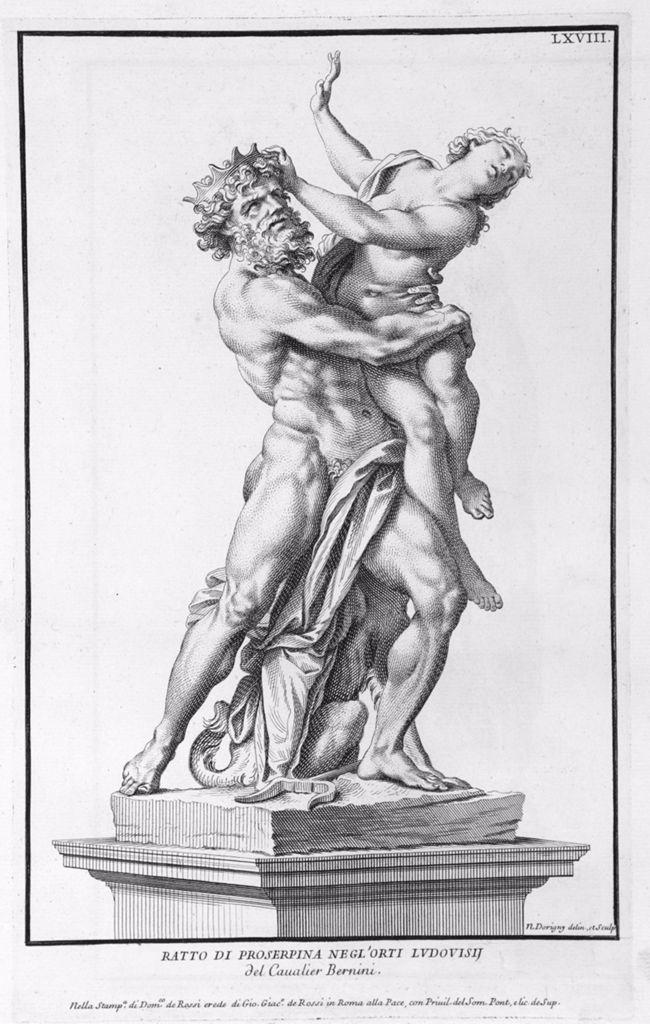
The Rape of Proserpina has been reproduced many times in a two-dimensional format in the centuries since its creation. Nicolas Dorigny (a French-born engraver) produced an engraving of the sculpture that was published in the volume “Domenico de and Paolo Alessandro Maffei. Raccolta di statue antiche e moderne” (1704) by Domenico di’Rossi3 as plate LXVIII. This image shows Bernini’s sculpture from a three-quarters angle, centralizing more on Pluto than Proserpina. Since travel was difficult in 1704 when the engraving was published, Dorigny’s reproduction may have been the only way for an individual in England to see the work.
What does a viewer lose when only seeing Bernini’s The Rape of Proserpina through Nicolas Dorigny’s engraving? For starters, only one vantage point of the sculpture is published in the 1704 volume, so readers would not have a reproduction of the back side of the figures. Any details that were carved outside of Dorigny’s reproduction vantage point would be virtually nonexistent to an individual looking at his engraving. While Dorigny’s engraving intentionally focuses on Pluto as the central figure in his reproduction—as evidenced by framing the engraving to have him as the
center of the image, not Proserpina—Bernini’s sculpture when viewed from the back shifts the attention to Proserpina. From the back, she is the central figure with the highest range of motion and emotion, not Pluto. Proserpina is physically higher than Pluto is due to her outstretched arm, drawing the viewer’s eye towards her. Moreover, the intricate movements in the fabric of her clothing highlight the surprise she felt as she was suddenly abducted by Pluto, as she is clothed from the back but nude from the front—suggesting she was caught in a state of surprise.

Image by Sailko via Wikimedia Commons (2017).
In reproducing only one vantage point of Bernini’s The Rape of Proserpina, Nicholas Dorigny’s engraving cuts out parts of the story told by Bernini—whether intentionally or unintentionally. Viewers are forced to see the story from a single perspective, mimicking the physical viewing experience relegated to a single perspective as well. Modern photographs still do the same thing. Photographs of Bernini’s work continue to exclude certain aspects of the three-dimensional sculpture. Many images taken from the same vantage point as Dorigny’s engraving completely exclude the inclusion of Cerberus beneath Proserpina, an important contextualization for the work’s story. The pressure with which Pluto grips Proserpina is also often missing from two-dimensional reproductions of the sculpture, as indicated by the strong grip he holds on her upper left thigh.
In the end, while two-dimensional reproductions are often the easier and more cost-effective method of digitizing works of three-dimensional art for wider distribution (and for many years were the only method of doing so), three-dimensional methods will always prevail over two-dimensional ones in accuracy. (Accuracy here being defined as a means of fully capturing all of the details of a work of art). Photogrammetric models of Bernini’s The Rape of Proserpina have been published online, allowing viewers to see the anguish on Proserpina’s face from a better angle, as she faces towards the ceiling in the ten-foot tall sculpture.
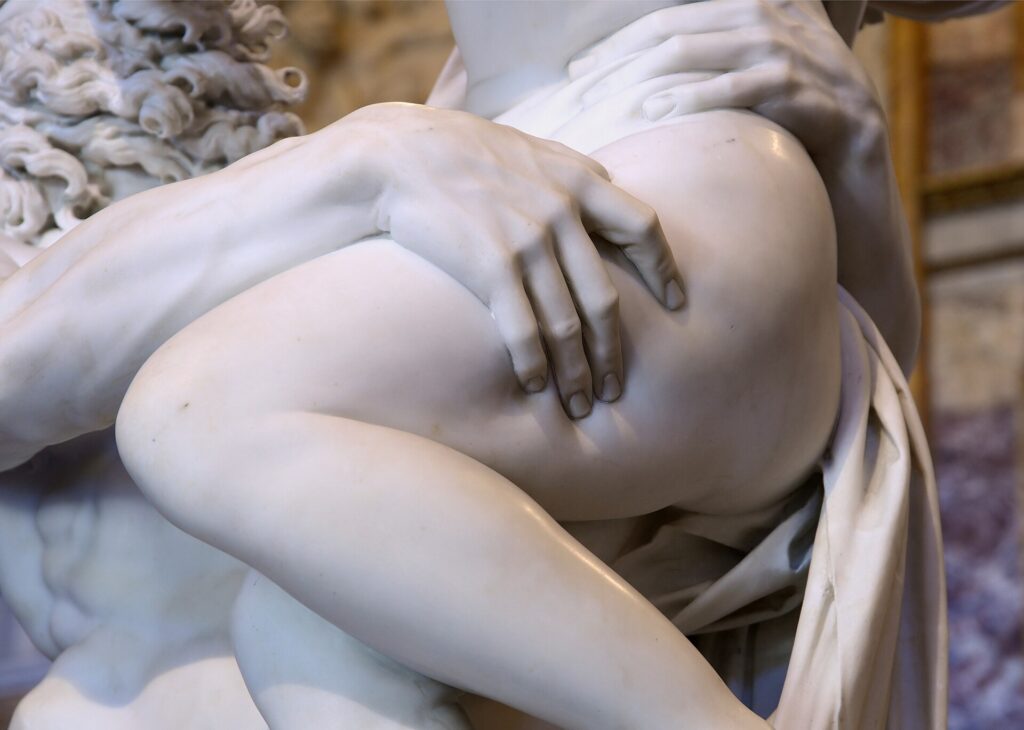
Image by Alvesgaspar via Wikimedia Commons (2015).
For the second part of my blog post I was tasked with uploaded scans completed earlier this week in class. We completed a digitization workshop in which each student scanned an image and a body of text of their choice. Adjustments were then made to the digitized files as needed in Photoshop, including cropping and minor color adjustments (for the image) and a very-unsuccessful attempt at OCR for the (handwritten) text. Apparently my handwriting is not legible to Adobe Acrobat.

Digitized scan of a postcard I received from a friend while she was in Athens.
Below is a scan of my reading notes from my museum studies seminar this semester. They come from an article assigned for reading: Carol Duncan and Alan Wallach, “The Museum of Modern Art as Late Capitalist Ritual,” in Preziosi and Farago, eds., Grasping the World, Part V, chapter 1.
I wouldn’t recommend you download them, unless you have a particular interest in Marxism and museum studies.
- Emma Stanford, “A Field Guide to Digital Surrogates: Evaluating and Contextualizing a Rapidly Changing Resource,” Routledge Companion, pp. 205. ↩︎
- Stanford, pp.207. ↩︎
- Rossi, Domenico de’, “Raccolta di statue antiche e moderne: data in luce sotto i gloriosi auspici della Santita di N.S. Papa Clemente XI.” Stamperia della Pace. Rome. 1704. Available online via Internet Archive. ↩︎


Leave a Reply