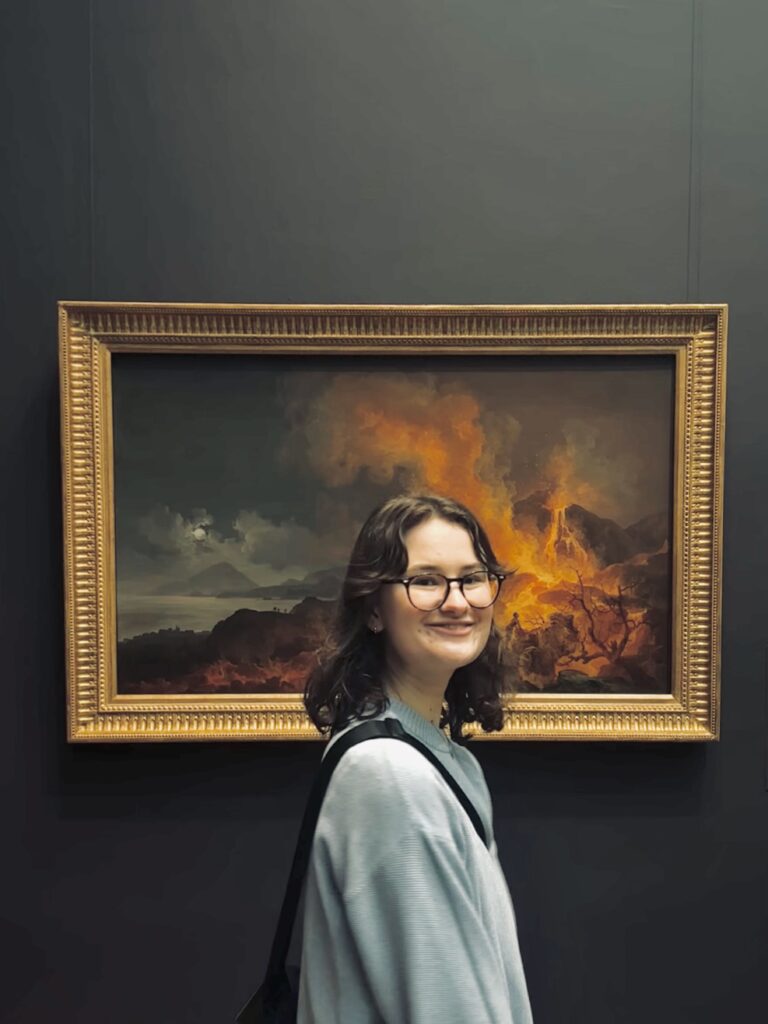
Kathryn Spears is a graduate student and researcher with a background in classical art and archeology, especially that of the Roman Empire. She is currently pursuing a double-master’s in art history (M.A.) and library science (M.S.) after receiving her bachelor’s in Archaeology and Classics from UNC Chapel Hill. Her research work is typically interdisciplinary, residing at the intersection of art history, classics, and history. Her research interests in classical art include ancient bronze sculpture (especially miniatures), Roman wall painting of Campania, and the iconography of Roman empresses. More broadly, she is also interested in receptions of classical art (especially in relation to the European Grand Tour, 1660-1840), the history of collecting, and museum studies in general.
She also has experience in collections management (both physical and digital) and library reference. She has strong interests in art-related databases and cataloging as she seeks to make visual material more accessible for researchers and the general public.
Completed Coursework
Below is an in-exhaustive list of completed and relevant coursework with accompanying descriptions and notable projects (if applicable).
Descriptions from UNC Chapel Hill’s academic course catalog (accessible here–>). Some courses may still be in-progress and additional ones will be added over time.
Art History (ARTH):
ARTH 484: Art, Empire, & Restitution Since 1800
A discussion-based course that examines the systems of value that confer special status on the broad category of cultural property, exploring a number of case studies of art theft and restitution since the early 19th century, with an emphasis on art theft during World War II and that undertaken under the aegis of European colonialism.
Project: “The Boubon Bronzes: A Case Study for Provenance Research”
ARTH 850: Methods in Art Historical Research
Introduction to a variety of historical and contemporary methods for the interpretation of visual culture.
ARTH 851: alt-Methods: Digital Art History
Introduction to current digital art history projects and practices as well as methods for approaching art historical research in new ways.
ARTH 950: Problems in the History of Art (Focus: Sensuality)
Project: “Aura and the Ara Pacis Augustae: the Museo dell’Ara Pacis as a Re-contextualization of the Altar’s Visual Experience”
ARTH 952: Seminar in Museum Studies (Focus: Critical Museum Studies)
ARTH 982: Seminar in American Art (Focus: Temporality)
Project: “Re-presenting Catastrophe: The Anachonic Temporality of Mount Vesuvius in Eighteenth Century Art”
ARTH 991: Graduate Writing Seminar
Devoted to structuring an argument, assessing primary and secondary sources, and conducting a sustained writing exercise. The goal of the Graduate Writing Seminar is to produce a prospectus of the thesis.
Classical Archaeology (CLAR) 910: Seminar in Classical Art Methods
Project: “Between Goddess and Empress: Iconographic Ambiguity in a Provincial Roman Bronze”
CLAR 910: Seminar on the Roman House
Project: “Memory, Myth, and Movement: Reading the Wall Paintings of Rooms 19 and 20 in the Casa del Citarista”
Information & Library Science (INLS):
INLS 520: Organization of Information
Introduction to elements of organizing systems: classes, instances, properties, values, and relationships. Provides fundamental principles applicable to a wide range of information organization activities, including data modeling, vocabulary design, information architecture, data curation, library cataloging, and more. Emphasis on social and cultural context.
INLS 523: Introduction to Database Concepts & Applications
Design and implementation of basic database systems. Semantic modeling, relational database theory, including normalization, indexing, and query construction, SQL.
INLS 525: Electronic Records Management
Exploration of the relationships between new information and communication technologies and organizational efforts to define, identify, control, manage, and preserve records. Considers the importance of organizational, institutional and technological factors in determining appropriate recordkeeping strategies.
INLS 556: Introduction to Archives & Records Management
Survey of the principles, techniques, and issues in the acquisition, management, and administration of records, manuscripts, archives, and other cultural and documentary resources in paper, electronic, and other media formats.
INLS 739: Programming & Outreach for Library User Population
Service, professional, and administrative issues related to information access by nontraditional information service users. The course examines trends, public policy, ethical issues, programming, and evaluation of services.
INLS 749: Art & Visual Information Management
A survey of the history and practice of art and visual resources librarianship/curatorship, with an emphasis on administration, collection development, copyright practices, digital resource management, and public service.
Project: The Roman Wall Painting Index (RWPI)–ongoing. Accessible here–>.
INLS 752: Digital Preservation & Access
Focuses on best practices for the creation, provision, and long-term preservation of digital entities. Topics include digitization technologies; standards and quality control; digital asset management; grant writing; and metadata.
INLS 776: Ethics, Values, & Society
Exploration of ethical issues related to information, data, knowledge, and technology in various individual, community, and societal contexts.
Project: “Game Over? The Ethical Dilemma of Game-Based Learning in Education”
INLS 777: Perspectives on Information, Technology, & People
Examination of the relationships between information, technology, and people from an array of disciplinary, professional, cultural, and other orientations. Survey from historical and future viewpoints. Explores the application of diverse perspective to understand current matters of concern.
INLS 779: Practicum Project Development
Preparation prior to conducting the capstone practicum. It includes a broad introduction to project management principles, tools, and strategies intended for use in a variety of applications.
INLS 783: Library Instruction & Pedagogy
Examines the role of school, public, and academic librarians in providing instruction. Pedagogy, learning theories, information literacy standards and curricula, and assessment methods are addressed.
Project: Online module designed to help academics convert papers to conference presentations. Available here–>.
Descriptions from UNC Chapel Hill’s academic course catalog (accessible here–>). List is not exhaustive and pertains to current area of study.
Anthropology (ANTH):
ANTH 123: Habitat and Humanity
Cross-cultural survey of building and landscape architecture, including prehistoric dwellings and sacred structures such as shrines and temples. Emphasis on architecture as symbolic form and cultural meaning.
ANTH 220: Principles of Archaeology
Introduction to method and theory in archaeology. An examination of how archaeologists make inferences about past societies, including reconstruction of culture histories; lifeways; ideologies; and social, political, and economic relationships.
ANTH 411: Laboratory Methods in Archaeology
The curation and care of archaeological collections. Students will learn about collections management through readings, discussion, lectures, and hands-on work at the Research Laboratories of Archaeology’s curation facility. The RLA curates collections mainly from the American South. Through the lens of the RLA collections, we’ll explore basic principles of curation and data management as well as issues that affect curation nation-wide and internationally
ANTH 419: Anthropological Applications of GIS
This is a beginner/intermediate Geographic Information System/Science (GIS/GISci) course designed to help students develop spatial analysis and data visualization skills using ArcGIS Pro software. The emphasis is on understanding the structure and efficient storage of GIS data (feature classes and geodatabases) and how to work with multiple different types of spatial data (vector, raster, and tabular). Students learn geoprocessing techniques to transform data based on spatial relationships; different methods to classify data based on attributes; and how to perform basic calculations using spatial geometry. This is done through lectures and weekly labs using real world data.
Archaeology (ARCH):
ARCH 395: Independent Study in Archaeology
Art History (ARTH):
ARTH 161: Introduction to American Art
This course surveys American art, architecture, and material culture from early European exploration of the Americas to the 1960s.
Classical Archaeology (CLAR):
CLAR 244: Greek Art and Archaeology
The historical development of the art and architecture of Greece from the Bronze Age through the Hellenistic period.
CLAR 247: Roman Art & Archaeology
This course explores the archaeology of the Roman world between the eighth century BCE and the fifth century CE, focusing on issues of urbanization, trade and consumption, colonization, and the Roman army.
CLAR 262:
CLAR 380: Life and Art in Ancient Pompeii
Exploration of the history and archaeology of Pompeii with the goal of better understanding daily life in the early Roman empire. The course proceeds topically, moving from an exploration of the city’s public spaces to an analysis of more private domains–houses, gardens, and tombs. We will also consider evidence from ancient literature and epigraphy.
CLAR 465: Roman Architecture
The development of architecture in the Roman world from the ninth century BCE through the fourth century CE. The course focuses on the development of urbanism and the function, significance, and evolution of the main building types and their geographic distribution.
CLAR 476: Roman Painting
Surveys Roman painting from 200 BCE to 300 CE, with emphasis on style, iconography, historical development of painting in its sociocultural, political, and religious contexts. Treats current debates in scholarship.
Project: “Spatial, Temporal, and Cultural Contextualization: An Analysis of Wall Paintings from Room R in the House of the Triclinium”
CLAR 492: The Archaeology of Greek Sanctuaries
This course is a survey of the archaeology and architecture of ancient Greek sanctuaries from the Late Bronze Age to the Roman period. It addresses the development of temple architecture, ritual assemblages, and votive practices.
Project: “The Maison de Fourni: a Suburban Villa on Delos”
Classics (CLAS):
CLAS 391: Junior Seminar
The topic of this course varies according to instructor, but in all cases is designed to bring together all departmental majors in their examination of a particular topic in the study of the ancient Mediterranean from an interdisciplinary perspective. Seminar format and research focus.
Project: “The ἱερὰ οἰκία at Eleusis: Exploring the Sacrality of the Sacred House”
Geography (GEOG):
GEOG 121: Geographies of Globalization
This course examines places and the connections between places to build critical understandings of the role of human geographies in global economic, political, social, and cultural systems.
GEOG 370: Geographic Information Science
A concept- and data-driven course that introduces students to geographic data and core geographic concepts. Students will interpret and evaluate spatial datasets from a variety of sources (including their acquisition, limitations, and ethical considerations), understand how geographic data is structured and represented, and apply foundational techniques in Geographic Information Science (cartography and geovisualization, remote sensing, and geographic information systems).
GEOG 477: Introduction to Remote Sensing of the Environment
Covers fundamental theory and mechanics of remote sensing, related theoretical aspects of radiation and the environment, and remote-sensing applications relating to terrestrial, atmospheric, and marine environments. Hands-on experience for application and information extraction from satellite-based imagery through biweekly laboratory assignments.
GEOG 491: Principles of Geographic Information Systems
A methods-driven course that builds on foundational GIScience knowledge to teach students how to design, execute, and evaluate advanced spatial analyses within a desktop Geographic Information System environment. The course emphasizes analytical reasoning, workflow development, and modeling, and independent project design for spatial analysis.
GEOG 592: Geographic Information Science Programming
This course will teach students the elements of GISci software development using major GIS platforms. Students will modularly build a series of applications through the term, culminating in an integrated GIS applications program.
Project: “Land Travel in the Ancient Mediterranean: Assessing Distance Covered and Time Take to Travel Between Cities in Ancient Rome”. A network analysis project in ArcGIS Pro.
Greek (GREK):
GREK 101: Elementary Classical Greek I
Comprehensive coverage of basic grammar and syntax in two semesters.
GREK 102: Elementary Classical Greek II
Comprehensive coverage of basic grammar and syntax in two semesters.
GREK 203: Intermediate Greek I
Review of fundamentals; reading primarily in selected prose texts, such as Xenophon, Plato, Lysias, or others.
History (HIST):
HIST 158: Early Modern European History, 1450-1815
Intellectual and social structures, dynamics of social and political change, principles of authority, and bases of revolution from the Reformation to the French Revolutionary and Napoleonic period.
HIST 226: History of Rome
Origins to the first two centuries CE. Focuses upon Rome’s growth as a world power and the shift from republican government to autocracy.
Project: “Coinage and Power: the Portrait Coins of Julius Caesar (44 BCE)”
Latin (LATN):
LATN 101: Elementary Latin I
The basic elements of Latin grammar, practice in reading and writing Latin, introduction to Roman civilization through a study of the language of the Romans. First semester of survey.
LATN 102: Elementary Latin II
The basic elements of Latin grammar, practice in reading and writing Latin, introduction to Roman civilization through a study of the language of the Romans. Second semester of survey.
LATN 203: Intermediate Latin I
Review of fundamentals. Sallust’s Bellum Cataline.
LATN 204: Intermediate Latin II
Review of fundamentals. Livy’s Ab Urbe Condita, select books.
LATN 221: Vergil
Systematic review of Latin grammar. Reading in Vergil’s Aeneid, normally two books (Books 2, 8) in Latin, and the remainder in translation.
Project: “Vergil’s Use of Future Historical Events in the Aeneid“