This page serves as a landing spot for many of my projects, including research assignments. Some projects may still be a work-in-progress and the page will be updated as needed.
Ongoing Projects
These projects are still ongoing as of September 2026 and will receive periodic updates.
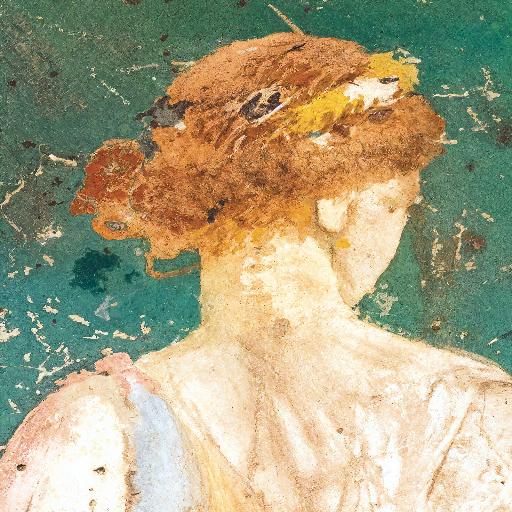
The Roman Wall Painting Index (RWPI) is a digital collection of ancient Roman wall painting from the Bay of Naples. Most paintings date from the second century BCE to the first century CE, with a hard cut off at 79 CE. These paintings are amongst the few surviving examples from antiquity, preserved only due to the destruction of cities such as Pompeii, Herculaneum, and Stabiae by the eruption of Mount Vesuvius in 79 CE.
Historically, Roman wall painting has been a very spatially-organized field. Volumes such as ‘Pompei: Pitture e Mosaici’ (1990-2003) have organized paintings by find spot, grouping together frescoes from the same buildings, insulae, and regi. The RWPI seeks to provide a space for researchers to examine Roman wall painting not just through spatial relation, but through subject and theme.
NB: the RWPI is an ongoing project as of September 2026. It current represents a small sample of Roman mythological panel paintings known to scholars and is in the process of expanding to include more works. The project is currently hosted on a Github server.
Accesible here–>.

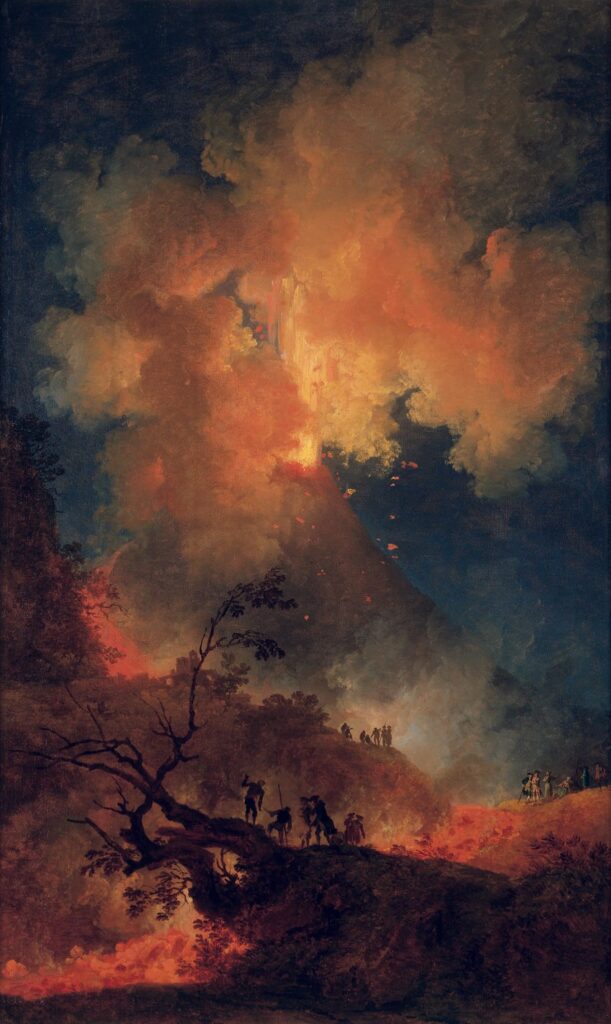
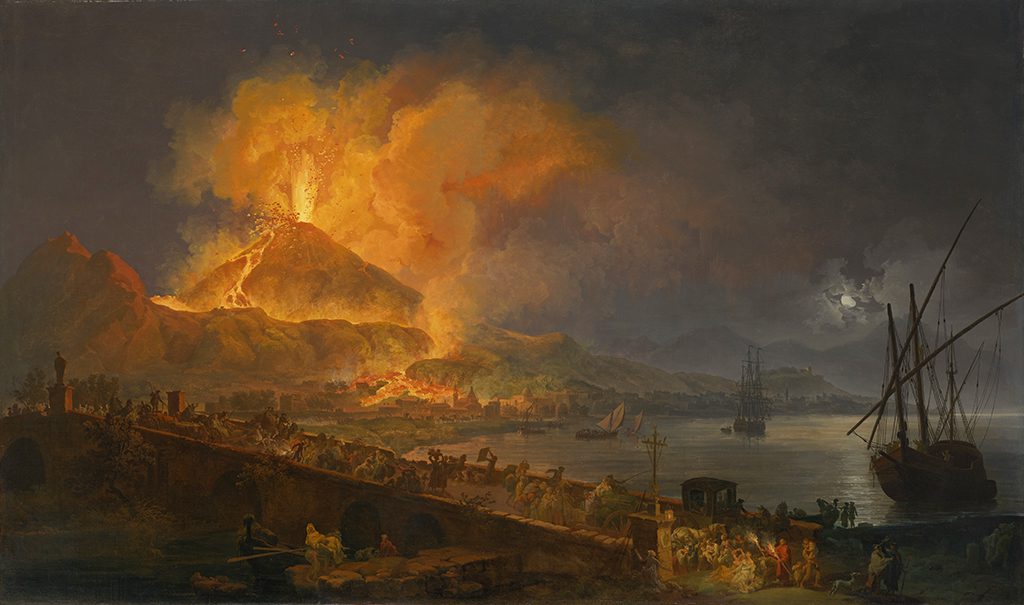
Pierre-Jacques Volaire’s The Eruption of Mt. Vesuvius (1777, North Carolina Museum of Art, Raleigh), presents a chaotic, fiery scene of the Neapolitan volcano in the midst of a destructive explosion. However, historical records indicate that while Vesuvius was particularly active in the eighteenth century, it was not experiencing a major eruption during the year of the painting’s commission. This paper investigates this temporal discrepancy by analyzing Volaire’s work through the theoretical lens of anachronic time—a concept describing how certain artistic motifs or subjects “linger” and persist through history, effectively blurring the lines between past and present. By interweaving eyewitness accounts of Vesuvian eruptions from ancient and early modern writers, the analysis reveals that many of Volaire’s visual choices mirror these trans-temporal literary descriptions, merging the eighteen century eruptions with the famed destruction of 79 CE.
NB: this is an ongoing project as of September 2026 and in the process of becoming a master’s thesis.
UNC-KCL Colloquium program accessible here–>
Completed Projects
For copyright reasons the majority of the research projects are unavailable to the general public. If one interests you, please feel free to email for a copy.
This paper explores the provenance of the Boubon bronzes, a group of life-size Roman bronze sculptures that appeared in Western art markets during the mid-1960s. Through an examination of individual provenance histories, the paper constructs a core provenance chronology tracing the bronzes’ movement from Boubon in Türkiye to collections in Europe and the United States, followed by their repatriation to Türkiye. The paper begins with the seizure of a bronze torso in 1967, which led scholars to connect the fragments with the sebasteion at Boubon. It then examines the Charles and Xenia Lipson collection and the dealers associated with the bronzes’ movement abroad. Using the Lipson history as a model, the paper evaluates additional bronzes according to their dates, stylistic similarities, alleged origins, and connections to antiquities trafficking. The paper concludes that a core provenance chronology can help identify objects of uncertain origin and assess their legal status more accurately in museum collections.
Completed May 2025
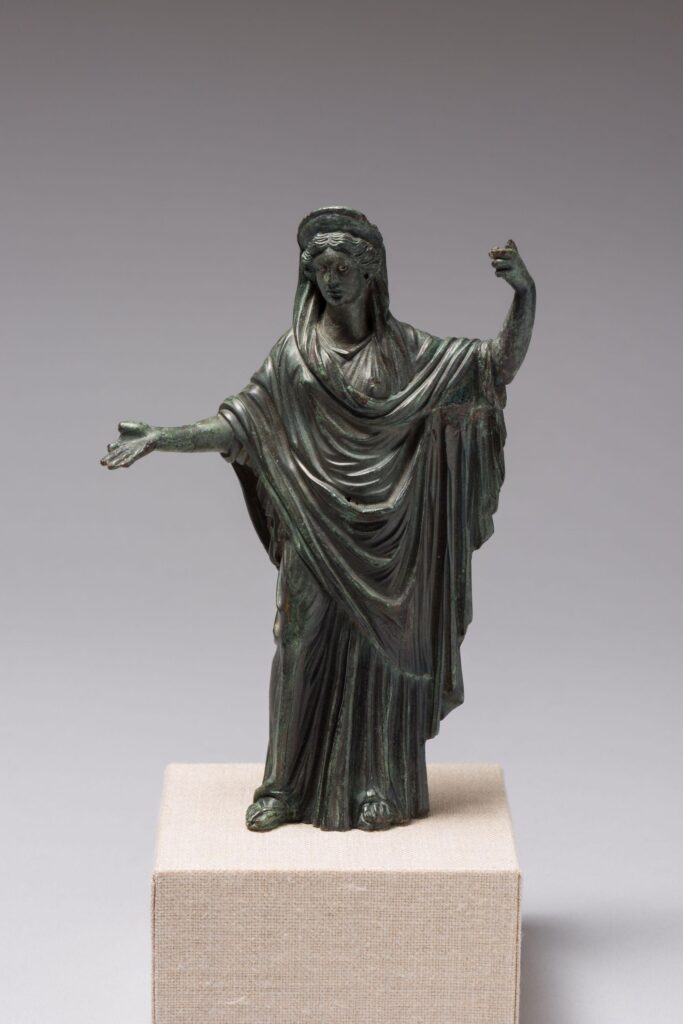
This paper examines the Ackland Art Museum’s Statuette of Juno (87.4), a hollow-cast bronze figure dating to the mid-second century CE, through its iconography, possible relation to imperial portraiture, and geographic dissemination. The statuette’s veiled head, diadem, raised left arm, extended right hand, and presumed scepter and patera place it within a recognizable Roman type associated with Juno’s authority, piety, and role in ritual practice. Comparisons with Antonine coins and portraits of Faustina the Elder and Faustina the Younger suggest that the figure may incorporate features of imperial empress portraiture, although the available evidence cannot establish a specific individual. Its uncertain findspot, probably in France, is considered alongside a closely related statuette from Weißenburg and depictions from the northwest provinces. These comparisons demonstrate the circulation of Juno’s imagery through coins, sculpture, and domestic or votive contexts, while emphasizing the statuette’s significance as either a divine image or an imperial portrait.
Completed March 2026
Program accessible here–>
Poster presented at the 2025 Graduate Research Symposium (UNC Chapel Hill) accessible here–>
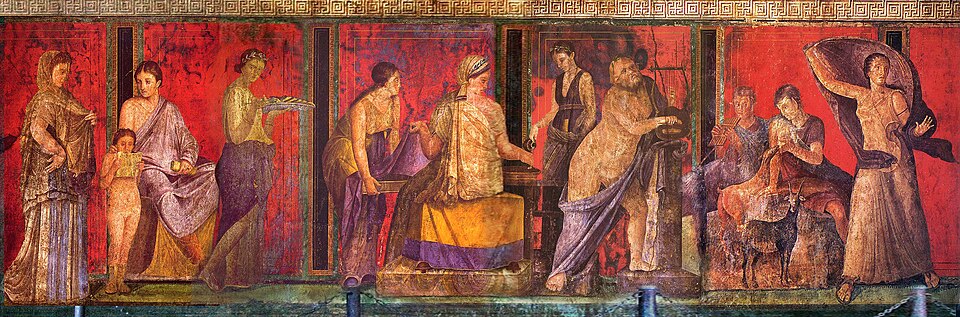
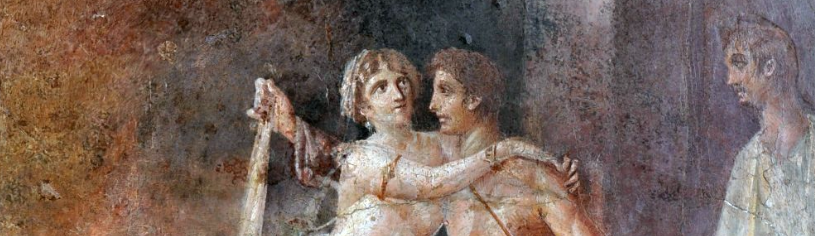
This paper examines the wall paintings of rooms 19 and 20 in the Casa del Citarista at Pompeii as an interconnected visual program within a late Republican entertainment suite. Drawing on Bettina Bergmann’s concept of the Roman house as a memory theater, it considers how guests moving between the triclinium and cubiculum might have connected seemingly distinct mythological scenes through memory, conversation, and movement. The paintings of reclining lovers, Laomedon, and Leda or Nemesis in cubiculum 20, together with the image of Antiope in triclinium 19, unite themes of love, deception, divine and mortal relationships, and Trojan genealogies. Their placement and scale also shaped the experience of Roman dining, presenting models of intimacy, fidelity, self-control, and proper guest-host conduct. Ultimately, the suite blurred distinctions between public and private space, transforming its paintings into an intellectual and social environment in which viewers actively reconstructed mythological meaning through shared acts of interpretation.
Completed December 2025
This paper examines the development and significance of Julius Caesar’s coinage between 54 and 44 BCE, focusing on the transition from coins bearing his name to coins displaying his portrait. Using the Coinage of the Roman Republic Online database, the paper categorizes Caesar’s coins into three types based on their legends, imagery, and issuers. The first type connected Caesar to military victories in Gaul and claimed descent from Venus, while the second introduced his political titles and status as imperator. The third type, issued in 44 BCE, depicted Caesar’s portrait alongside the title dictator perpetuo and imagery associating him with Venus and Victory. This shift represented a departure from Republican traditions, in which political figures were not normally portrayed on coinage. By circulating his image among ordinary Romans, Caesar connected himself to divine ancestry, military success, and political authority, signaling an authoritarian motive that likely intensified opposition to his rule.
Completed May 2024
This paper examines Richard Meier’s Museo dell’Ara Pacis as a modern re-contextualization of the Ara Pacis Augustae’s visual presence and aura. Focusing on the museum’s main exhibition hall, the paper considers how architectural features—including floor-to-ceiling glass walls, skylights, forced symmetry, and expanded visitor pathways—shape the experience of the ancient altar. After outlining the Ara Pacis’ original location on the northern Campus Martius and its relationship to Augustus’ mausoleum and the Horologium-Solarium, the paper compares Meier’s design with Vittorio Ballio Morpurgo’s earlier enclosure, which provided limited light, space, and visual access. Drawing on Walter Benjamin’s theory of aura, the paper argues that the Ara Pacis’ original outdoor setting was essential to its visual and symbolic presence. Although preservation concerns prevent the altar from returning outdoors, Meier’s design reintroduces natural light, movement, and spatial openness, allowing modern visitors to experience a dynamic visual environment that recalls the altar’s ancient display conditions once again.
Completed May 2026
This paper examines the extent to which the Sacred House at Eleusis can be considered a sacred space through a re-evaluation of its archaeological evidence, architecture, and chronology. Establishing sacrality requires both a connection to a religious system and evidence of human intent, although the latter can rarely be known with certainty from archaeological remains. The paper evaluates finds from the Sacred House, including a bothros, ceramic vessels associated with ash layers, a cult bench and enclosure, votive figurines, sacrificial pyres, and a burial tumulus. These materials are then considered alongside the building’s architectural development and compared with structures of the Eleusinian Telesterion. Although architecture and chronology alone cannot prove sacrality, similarities between the two sites, their construction on the same land, and the Sacred House’s association with ritual materials suggest that the area functioned as sacred land.
Completed May 2023