20 September 2026
Data can be hard. It’s tedious to collect and oftentimes difficult to work with, existing only as numbers or text strings that seemingly have no true meaning. One mishap in the data-collecting process can spell disaster for the project overall, leading to errors and readability issues.
For this week’s blog post, I decided to analyze Susan Elizabeth Gagliardi and Constantine Petridis’ “Mapping Senufo: Making Visible Debatable Information and Situated Knowledge” (2022)1 because I found that the authors ran into a lot of the same issues in their data-collecting process that I have in the past. Gagliardi and Petridis’ article stems from a project undertaken at the Art Institute of Chicago, Mapping Senufo: Art, Evidence, and the Production of Knowledge. Originally started in 2020, the project sought to examine traditional arts hailing from Western Africa that have been identified as Senufo–a family of languages from what is today Burkina Faso, Côte d’Ivoire, and Mali.
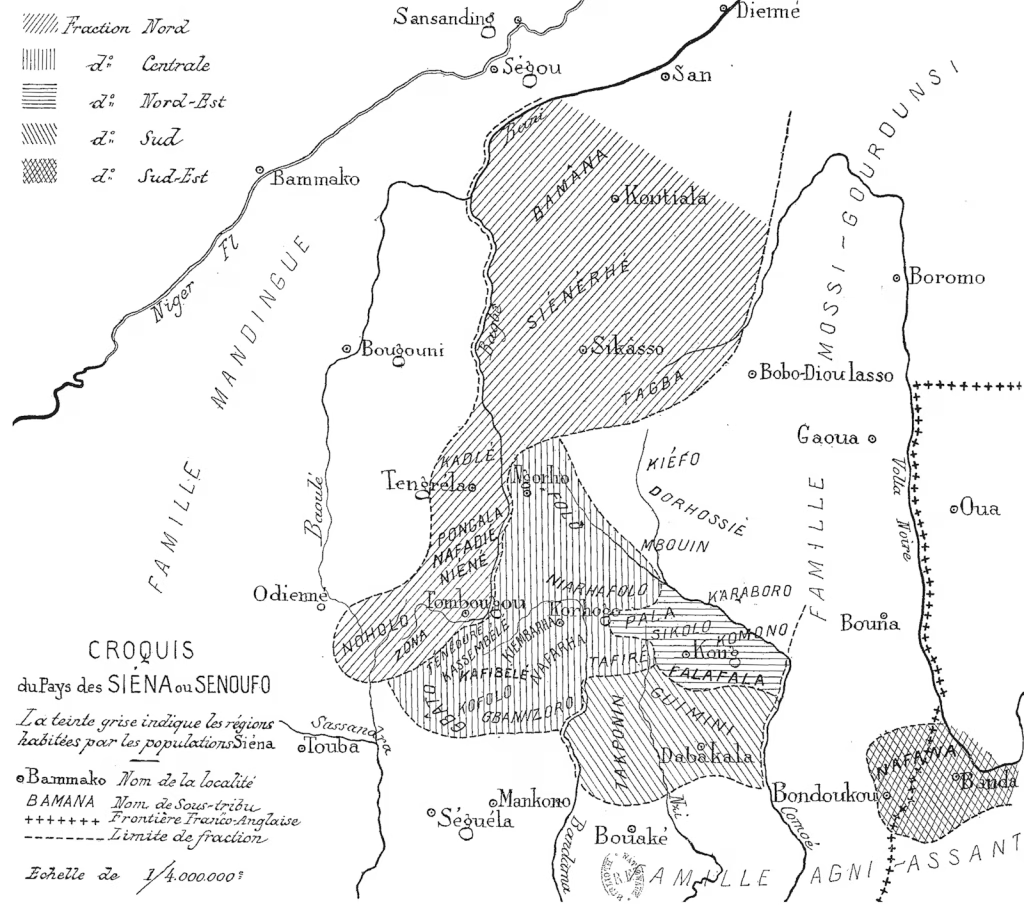
Map of Senufo area in 2026 via Google Maps
Senufo-associated objects first entered Western museum collections beginning in the early twentieth century. As Europeans explored the region of Western Africa, they wrote home of the works of art from the region2. In doing so, visiting Europeans grouped together all of these objects from different cultures under the Senufo label, stripping them of their original cultural contexts. The Mapping Senufo project aimed to re-associate “Senufo” objects with their original geographic locations, therefore returning them to the cultures that once created them.
While a simple idea in theory, the Mapping Senufo project was immediately met with roadblocks. Many of the Senufo objects lacked complete provenance records–a product of the methods oftentimes used by Europeans to remove African objects from their homes. For the objects that did have any kind of known geographic origin, researchers on the projects ran into name discrepancies. Small villages oftentimes had different names over time, and the names attributed to these villages were different to the Europeans who removed the objects than they were to locals who lived there.
Compiling and Populating the Mapping Senufo Database
Researchers at the Art Institute of Chicago started the Mapping Senufo database by creating a descriptive schema. This standardized form would be used by researchers to input the metadata (the data about the individual objects) into the database on a consistent basis, reducing the possibility of database errors. The data was sourced from the Art Institute of Chicago’s collections management system (CMS)–the digital system that kept catalogued information about the museum’s objects. A CMS is typically organized around a series of required built-in fields, such as Title [of work], Artist, Medium, and Date.
While the Senufo objects in the Art Institute of Chicago’s CMS have all of these required fields since they are necessary to input a record into the database, the fields are not well-suited for objects like the Senufo ones. Fields are designed around the collections sourcing from Western art movements like the Renaissance and more modern periods. Works from these periods of art typically have a relatively complete “tombstone” (as Gagliardi and Petridis refer to these required fields as) due to their more-complete provenance histories. Moreover, the Western works of art that these collections management systems are based on traditionally already have all of the tombstone elements a CMS needs. Paintings from the eighteenth-century usually have documented and attributed artists, as well as artist-assigned titles. Scholars are generally fairly certain about a work’s date of creation, allowing them to assign a painting a specific year of production.
Issues With Inequities in Descriptive Schemas
For objects outside of the “standard” Western art canon, this system does not fit. Information about objects in the Senufo collection is more uncertain. Scholars and curators do not always know where an object originates from or how to came to the museum. In many cases the provenance for objects like those in the Senufo collection is simply the year the object was acquired by the museum. This lack of information makes it incredibly difficult to fit the Senufo objects–and any objects outside of the Western art canon from the last few centuries–into the fields the Mapping Senufo projects needs to include.
When creating a database descriptive schema, there have to be a series of required fields. Without these fields the database cannot be searched and there is no way to link objects together. Some of these fields are designed to be completely unique and arbitrary, such as a museum accession number (a unique ID). However, many others will ultimately be duplicate fields–especially if information is unknown. For example, a collection holding two different works by the same artist will generate two results when searched by artist name. In this case, there is not a significant issue in the search-ability of the dataset since users may look for all works in the collection by the a single artist. But, issues arise when fields like Title [of work] and Date are non-specific and when there is conflicting information.
Gagliardi and Petridis note in their article the issues surrounding the title and identification of many of the objects in the Senufo collection. Many objects have no set title and were not always associated with the Senufo region, making them almost impossible to track in auction and private records before arriving at a museum. An object known as “Senufo mask” in 2026 may have been sold at an auction as “West African mask” or “[Specific tribe] mask” in 1960. Without images–and many auction catalogs before the 1990s did not publish images for all lots in a sale–it would be nearly impossible to link these two records to the same object.
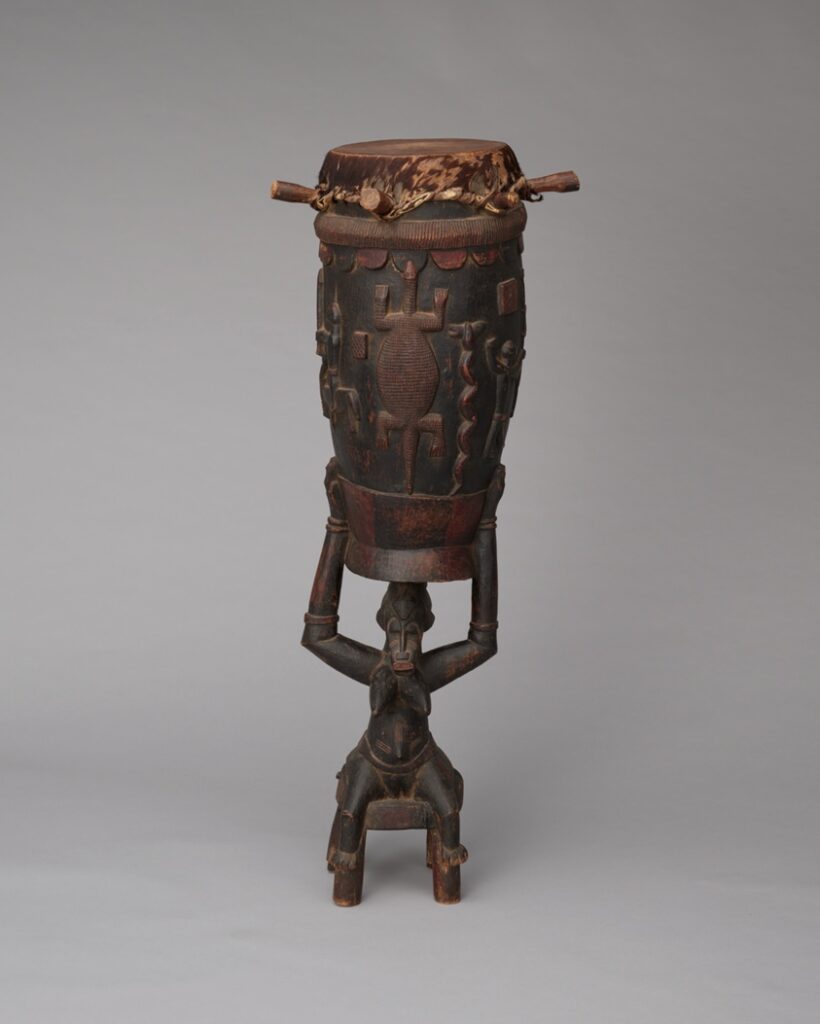
Female Caryatid Drum (Pinge)
Senufo, 1990.137
c. 1930-1950
Côte d’Ivoire (Object made in)
Wood, hide, and pigment
125.8 × 50.8 × 50.8 cm (49 1/2 × 20 × 20 in.)
Provenance: Charles Ratton (died 1986), Paris, by 1957 [see Cannes, Arts D’Afrique et D’Oceanie, 1957; Senufo Sculpture from West Africa, 1963; Goldwater, 1964, no. 165]; sold to Harry A. Franklin (died 1983), Harry A. Franklin Family Collection, Beverly Hills, Calif., early 1960s [personal communication from Valerie Franklin 2/26/2014]; by descent to Valerie Franklin, to 1990 [see Marie-Therese Brincard, 1990, p. 103]; sold, Sotheby’s, New York, Apr. 21, 1990, The Harry A. Franklin Family Collection of African Art, lot 47, as A Senufo Memorial Drum, to the Art Institute, 1990.
Note the change in name from 1990 sale to 2026.
The lack of provenance as exemplified above is just one of the reasons it is difficult to place Senufo objects in the Mapping Senufo database. By what name do researchers refer to objects in their collection? Should they prioritize the oldest known name, even if it might be misleading or incorrect? Or should researchers prioritize the most recent name of an object–even if it too may be misleading or incorrect. For the Mapping Senufo objects, the entire goal of the project is to identify if the objects are in fact “Senufo“; how can researchers do that if the data they are starting with is inaccurate to begin with?
Turning towards the types of data that we examined in class this week, I am particularly interested in working more with spatial data—which we have not covered in detail yet. I have a minor in geographic information systems (GIS) from undergrad, so working with spatial data is kind of my bread and butter. That said, I do not actually get to work with spatial data on art history-related projects very often, so I am interested in bringing that component to my own research.
Looking ahead in the semester, I considering seeing if I can map out some of the paintings of Mount Vesuvius that I am working with for my master’s thesis. The works depict Vesuvius in eruption from a variety of different angles (most grouped into three main vantage points). Not sure how useful of a digital project this would be for the general public, but it would probably be helpful in wrangling together the 70+ paintings by a single artist that I am examining.
(I started putting together some of the Vesuvius paintings in my CollectionBuilder assignment for this week, which can be viewed here–>).
- Susan Elizabeth Gagliardi and Constantine Petridis, “Mapping Senufo: Making Visible Debatable Information and Situated Knowledge,” in Perspectives on Data, ed. Emily Lew Fry and Erin Canning (Art Institute of Chicago, 2022). ↩︎
- Gagliardi and Petridis, 2022, n.p. ↩︎


Leave a Reply